Species Guide
A comprehensive reference to the marine macroalgae of British Columbia's Sunshine Coast. Profiles include taxonomy, habitat, ecological role, and traditional and modern uses. All species depicted with custom botanical illustrations in the tradition of 19th-century natural history plates.
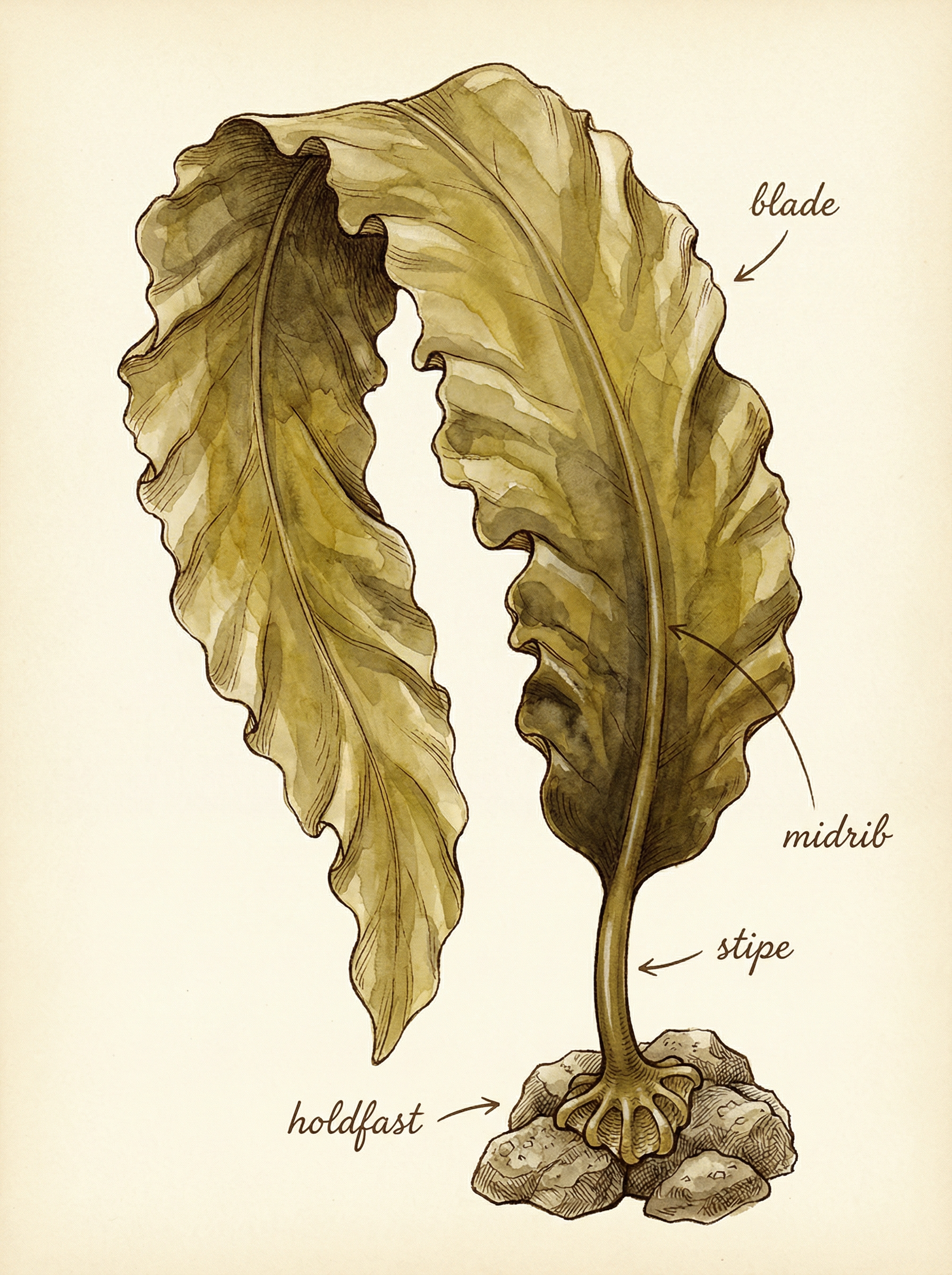
Sugar Kelp
The primary species for fermented kelp products. Wide, undulating blades with characteristically ruffled (undulate) margins and a sweet taste when fresh due to high mannitol content. Exceptionally rich in alginates, fucoidan, laminarin, and phytohormones. A low intertidal and subtidal species, used for slow fermentation into kelp preparations.
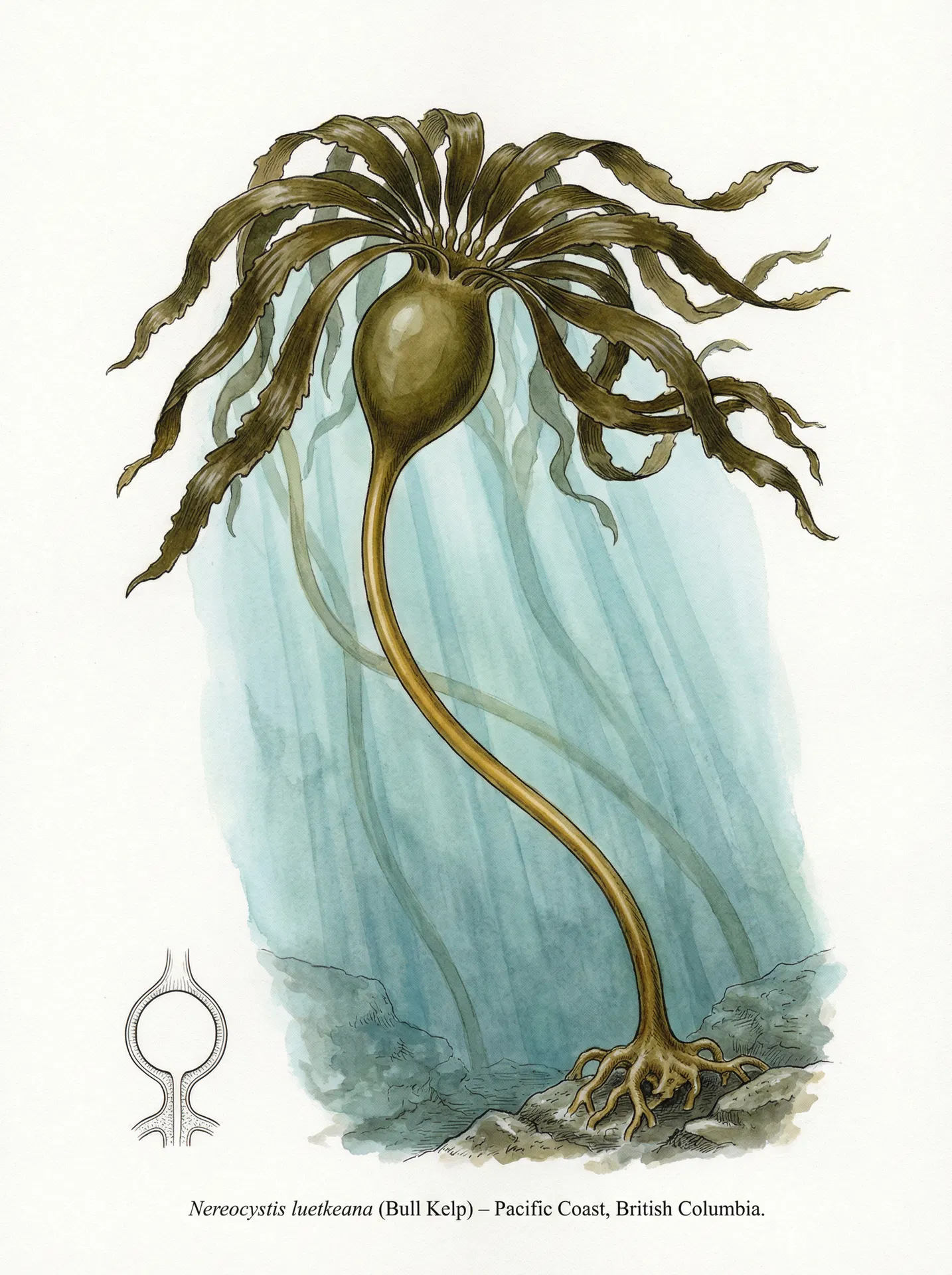
Bull Kelp
An iconic species of the BC coast, forming dense underwater forests. A single hollow stipe topped with a large pneumatocyst (float) supports numerous blades. Annual species — dies back each winter and regrows from spores.
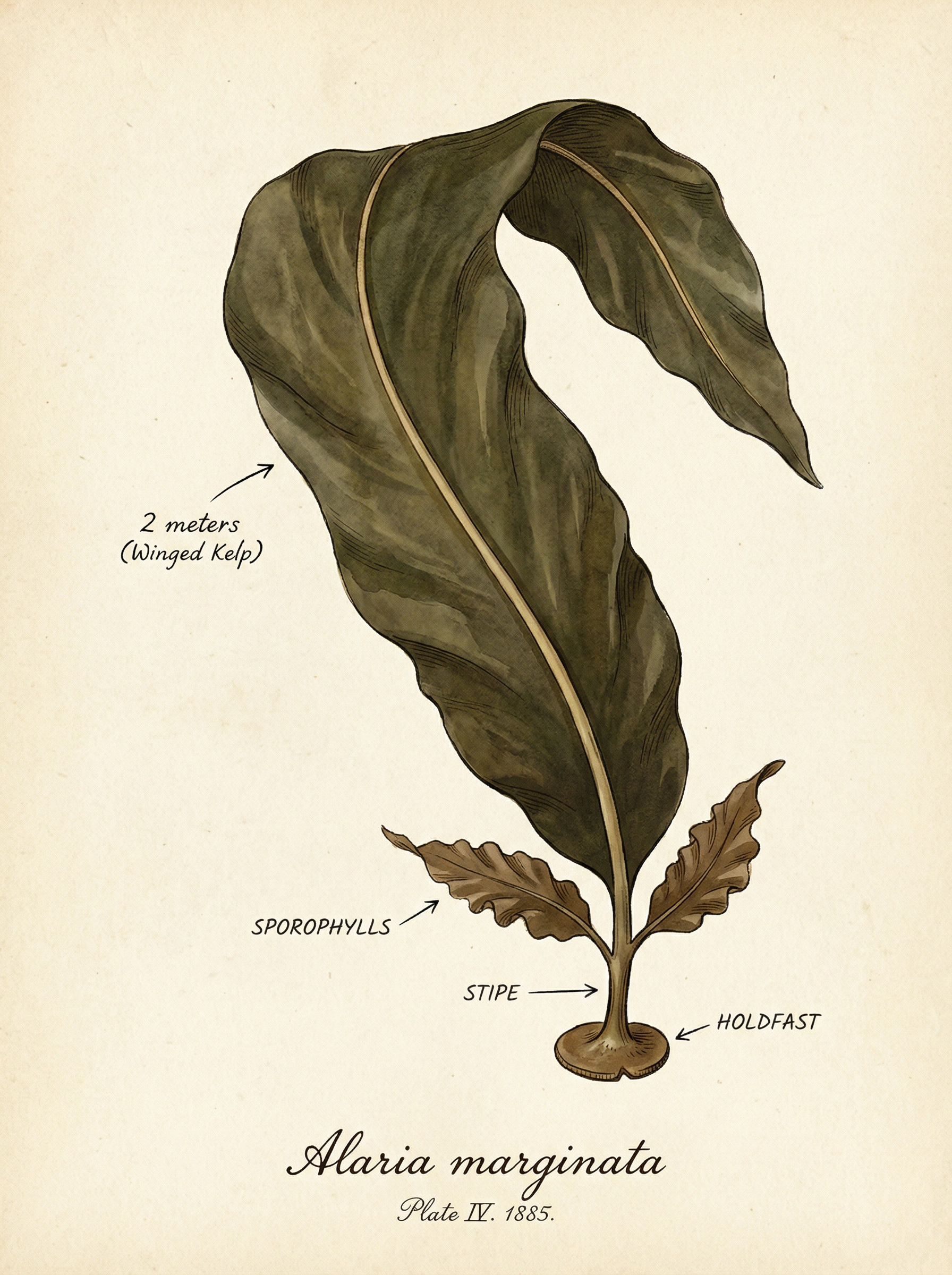
Winged Kelp
Distinctive midrib running the length of the blade with sporophylls (reproductive blades) at the base. Prized in culinary applications for its rich umami flavour. Found in areas with strong currents and wave action.
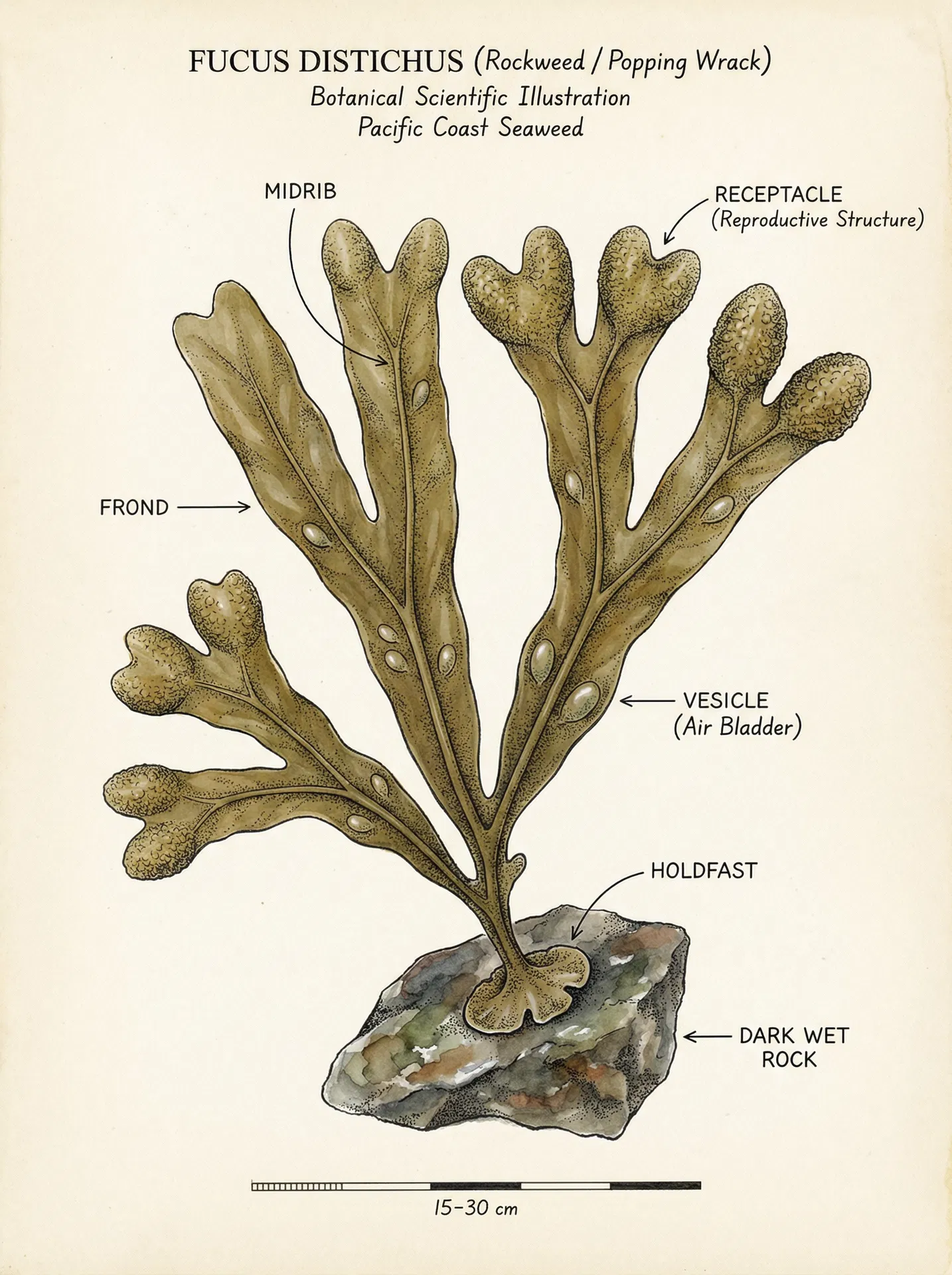
Rockweed
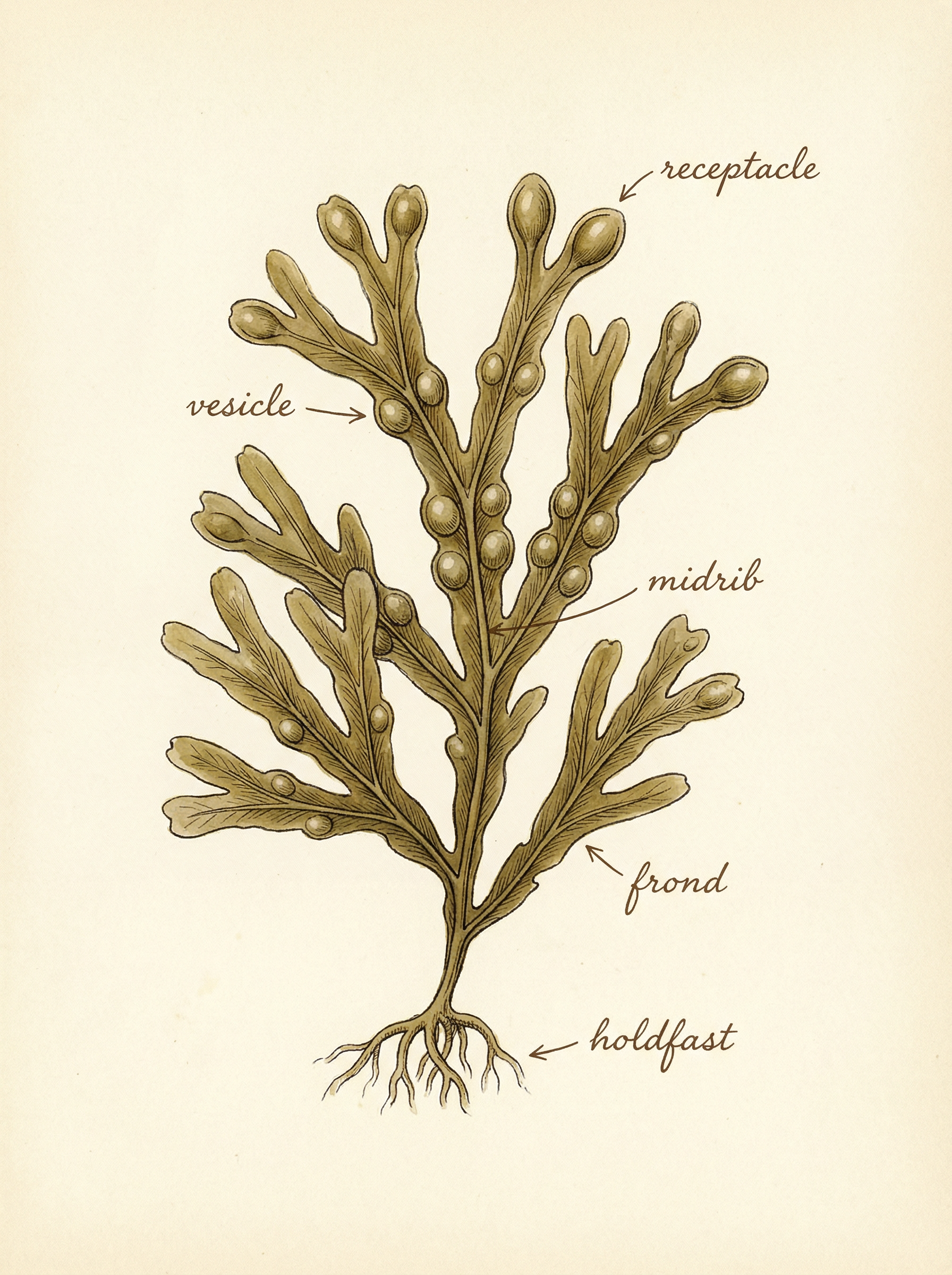
One of the most dominant species of the higher intertidal zone. Dichotomously branched fronds with swollen, mucilage-filled receptacles at the tips. Highly tolerant of desiccation — can lose up to 90% of its water content and recover fully when re-wetted. A keystone species of the BC intertidal.
Bladderwrack
Branched fronds with paired air bladders (vesicles) that keep the fronds buoyant at high tide. Primarily an Atlantic species; present on the BC coast in limited populations. Used in traditional medicine for thyroid conditions due to its high iodine content. Rich in fucoidan and alginates.
Giant Kelp
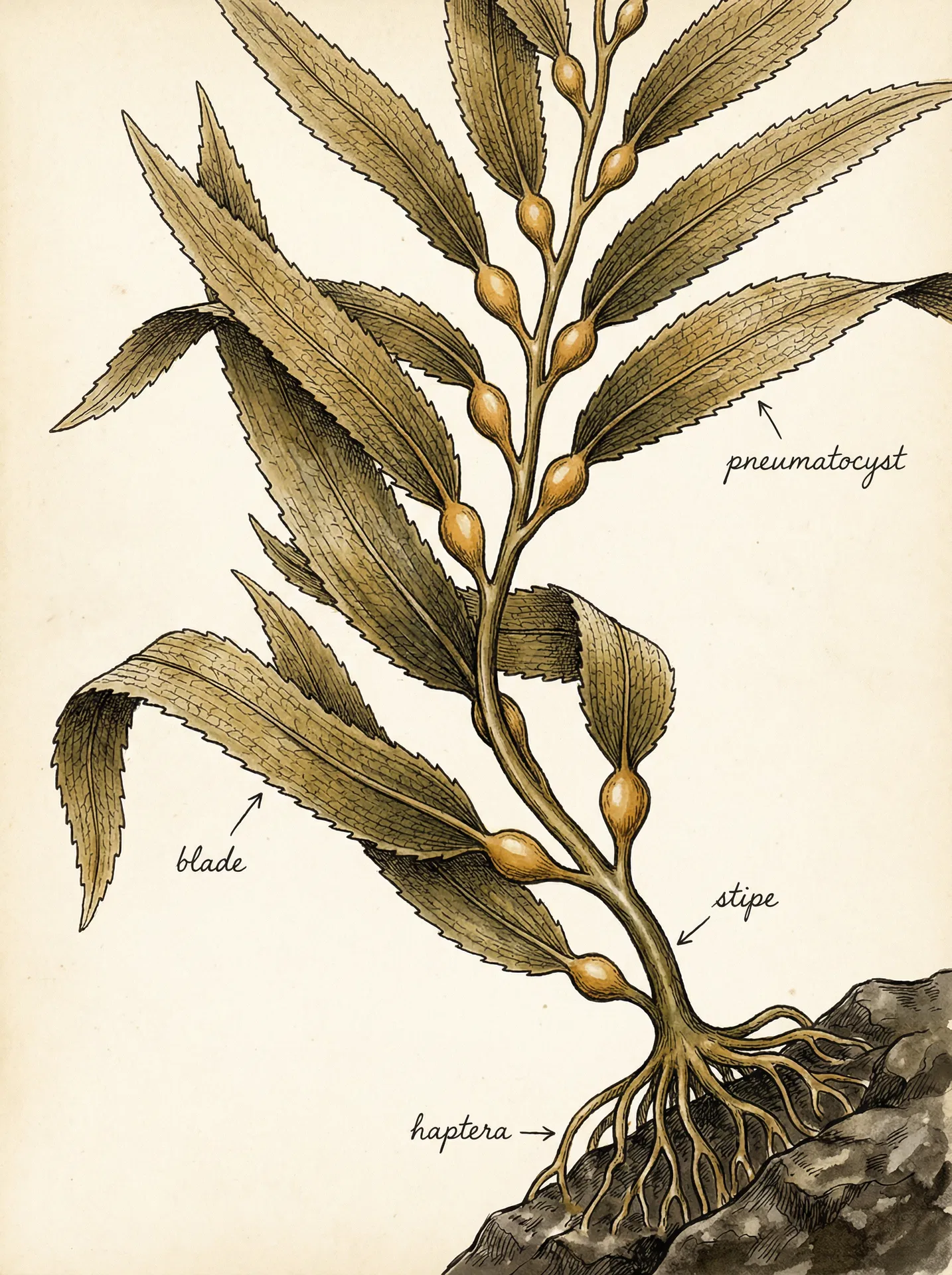
One of the largest organisms on Earth. Forms extensive underwater forests providing three-dimensional habitat for hundreds of species. Each blade has a small pneumatocyst (gas bladder) at its base, holding the canopy near the surface. At the northern edge of its range on the BC coast — present in small peripheral populations. Used globally for alginate production.
Feather Boa Kelp
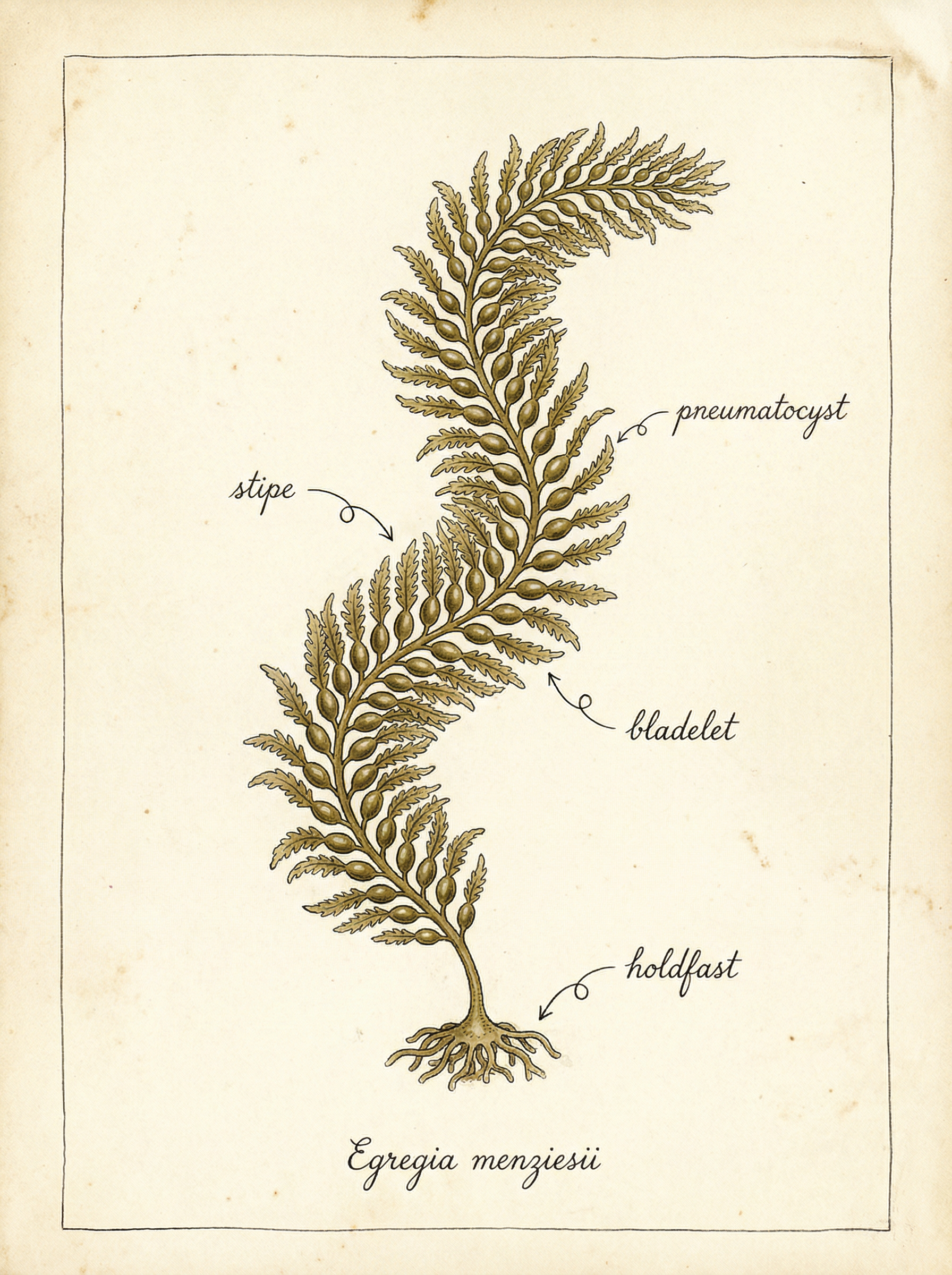
Unmistakable appearance — a long, flexible stipe densely covered in small leaf-like blades and oval floats, resembling a feather boa. Found in areas with strong currents. Provides habitat and helps stabilize sediments.
Wireweed
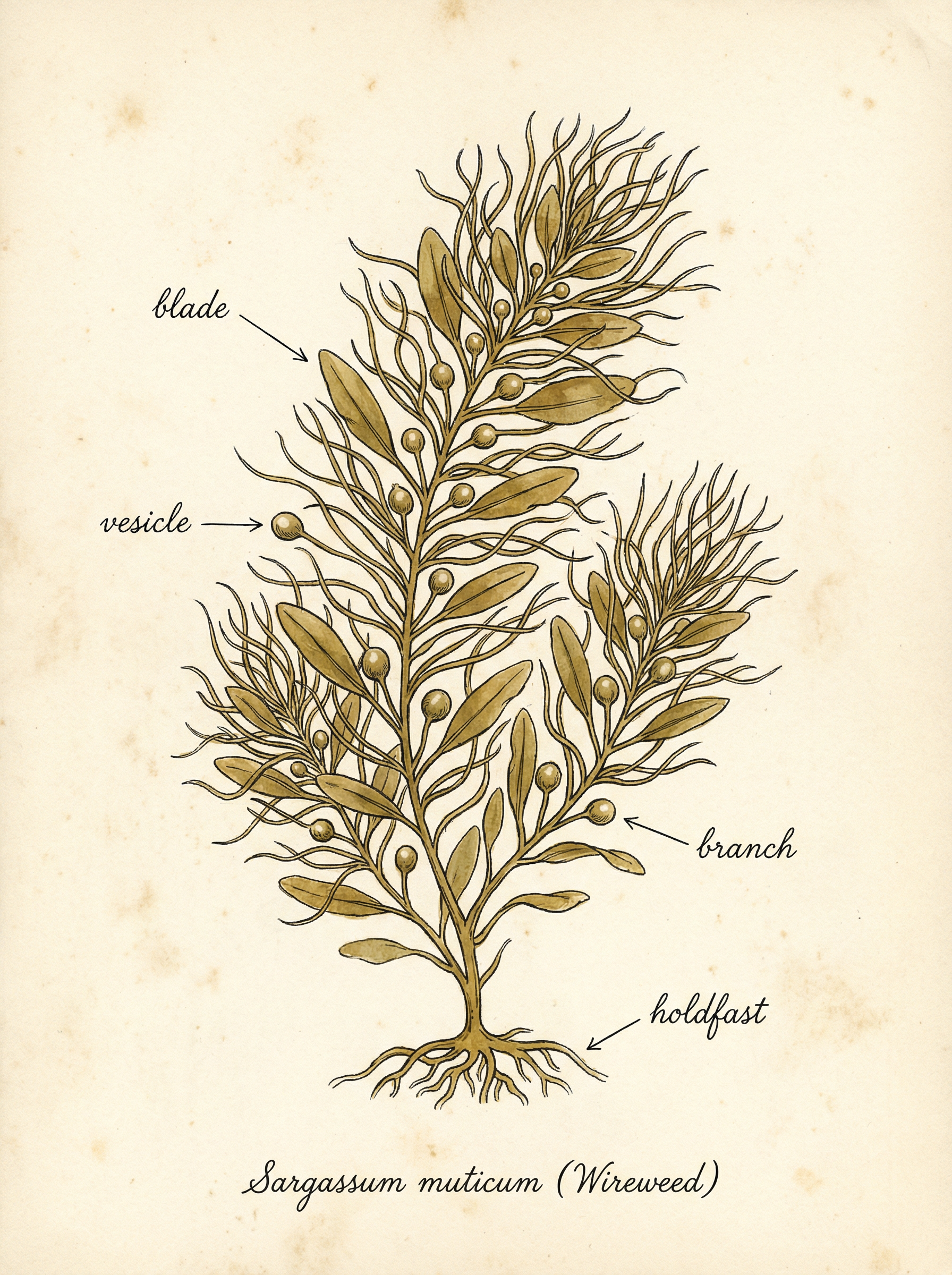
An invasive species from Japan, introduced to BC via oyster aquaculture imports. Now widespread on the BC coast, forming dense, tangled mats in sheltered bays. Competes aggressively with native species for space and light. Tolerates a wide range of temperatures and salinities.
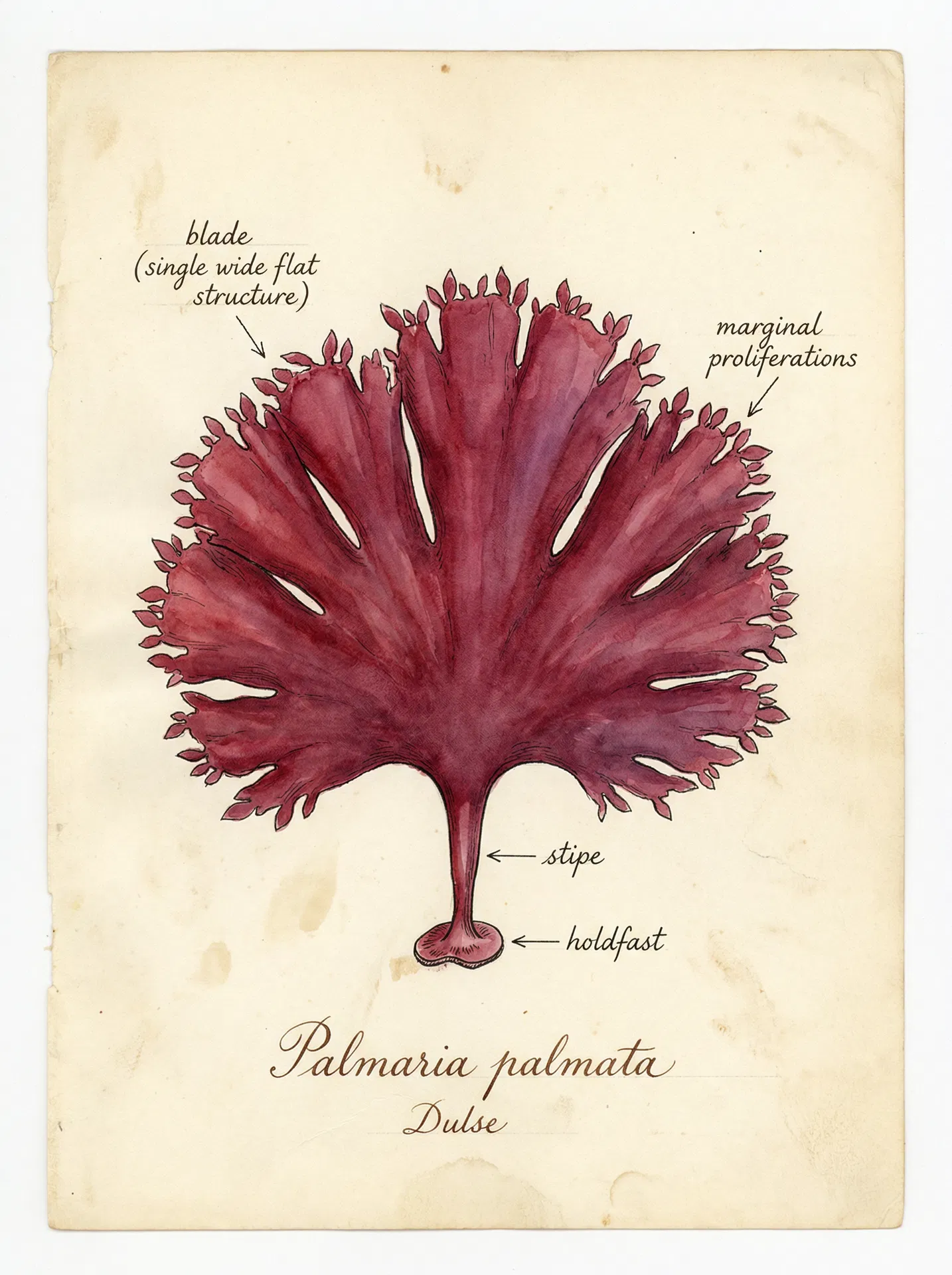
Pacific Dulse
A highly nutritious red alga with flat, fan-shaped blades and small proliferations (bladelets) along the margins. The Pacific species (P. hecatensis), distinct from the Atlantic P. palmata. One of the most widely eaten seaweeds in the world, with a salty, slightly spicy flavour when dried. Rich in protein (up to 35% DW), vitamins B12 and C, and iron.
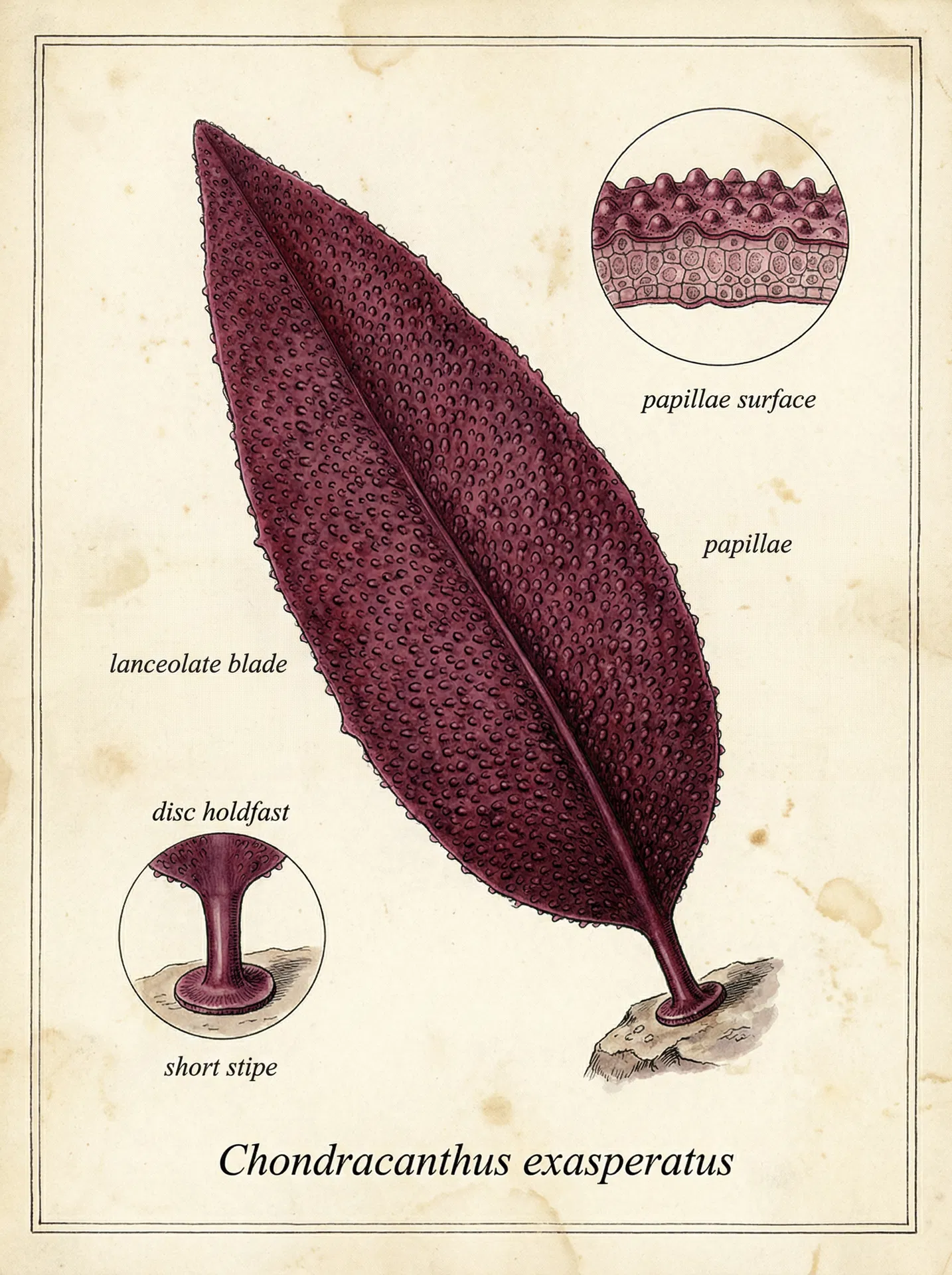
Turkish Towel
A robust red alga with one or more broad, flat, lanceolate blades — wide in the middle and tapering at both ends, like a wide paddle. Both surfaces are densely covered in papillae (small bumps), giving the rough texture that inspired the common name. Deep purplish-red with a bluish iridescence when submerged. A commercial source of carrageenan — a polysaccharide used as a thickener and stabilizer in food and cosmetic products.
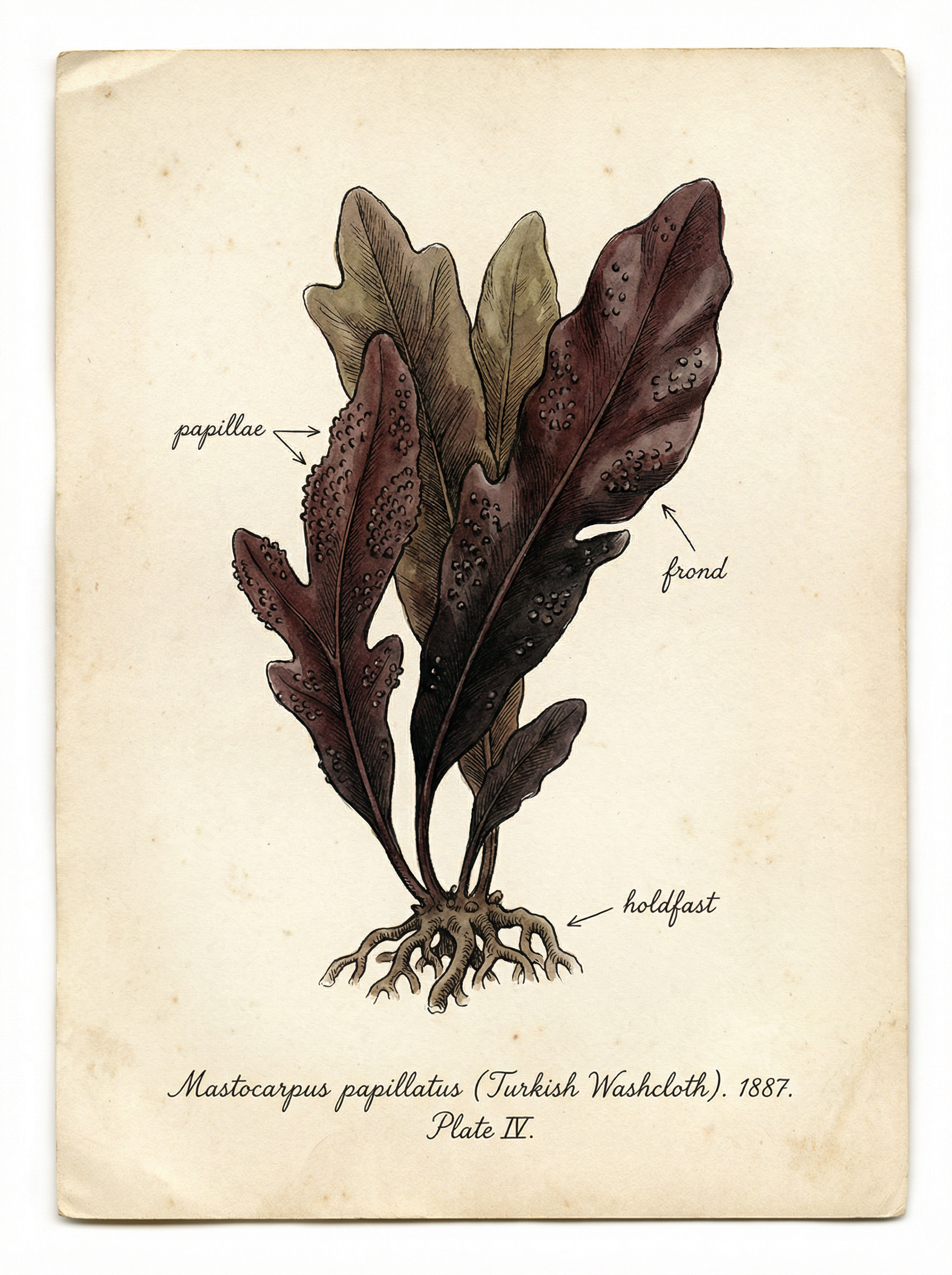
Turkish Washcloth
Thick, leathery fronds covered in small wart-like papillae. Has a remarkable two-phase life cycle: the erect gametophyte (the familiar 'Turkish Washcloth') alternates with a crustose sporophyte phase (formerly classified as the separate genus Petrocelis) that appears as a dark tar-like crust on rocks. Often found growing alongside Fucus species in the mid-intertidal zone.
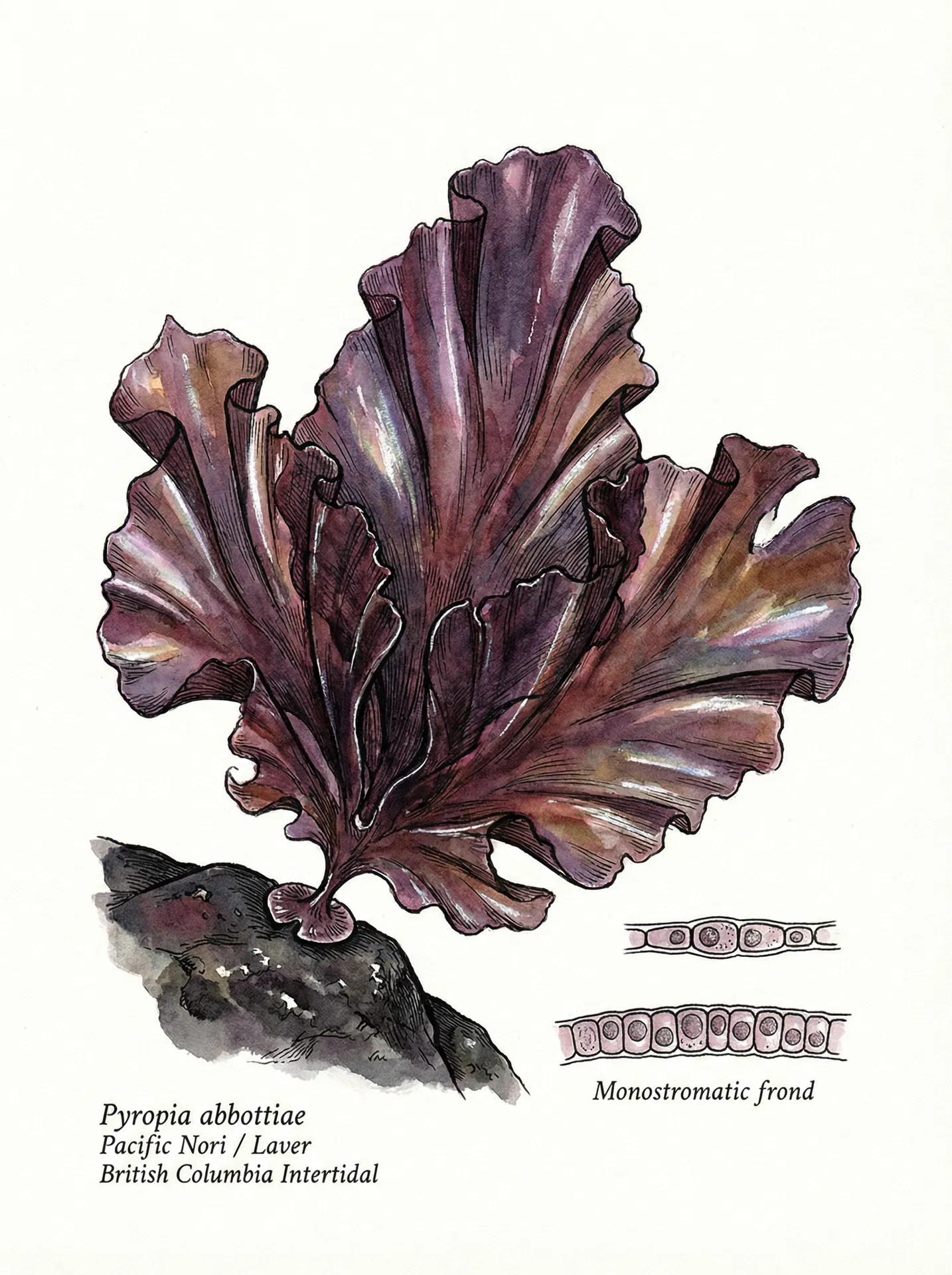
Nori
Thin, sheet-like monostromatic fronds (one cell thick) varying from dark purple to reddish-brown. The BC Pacific nori species, used by First Nations peoples of the BC coast including the Kwakwaka'wakw and Gitga'at for centuries. The basis of the global nori industry — dried and used to wrap sushi. Rich in protein, vitamins A, B12, and C, and omega-3 fatty acids.
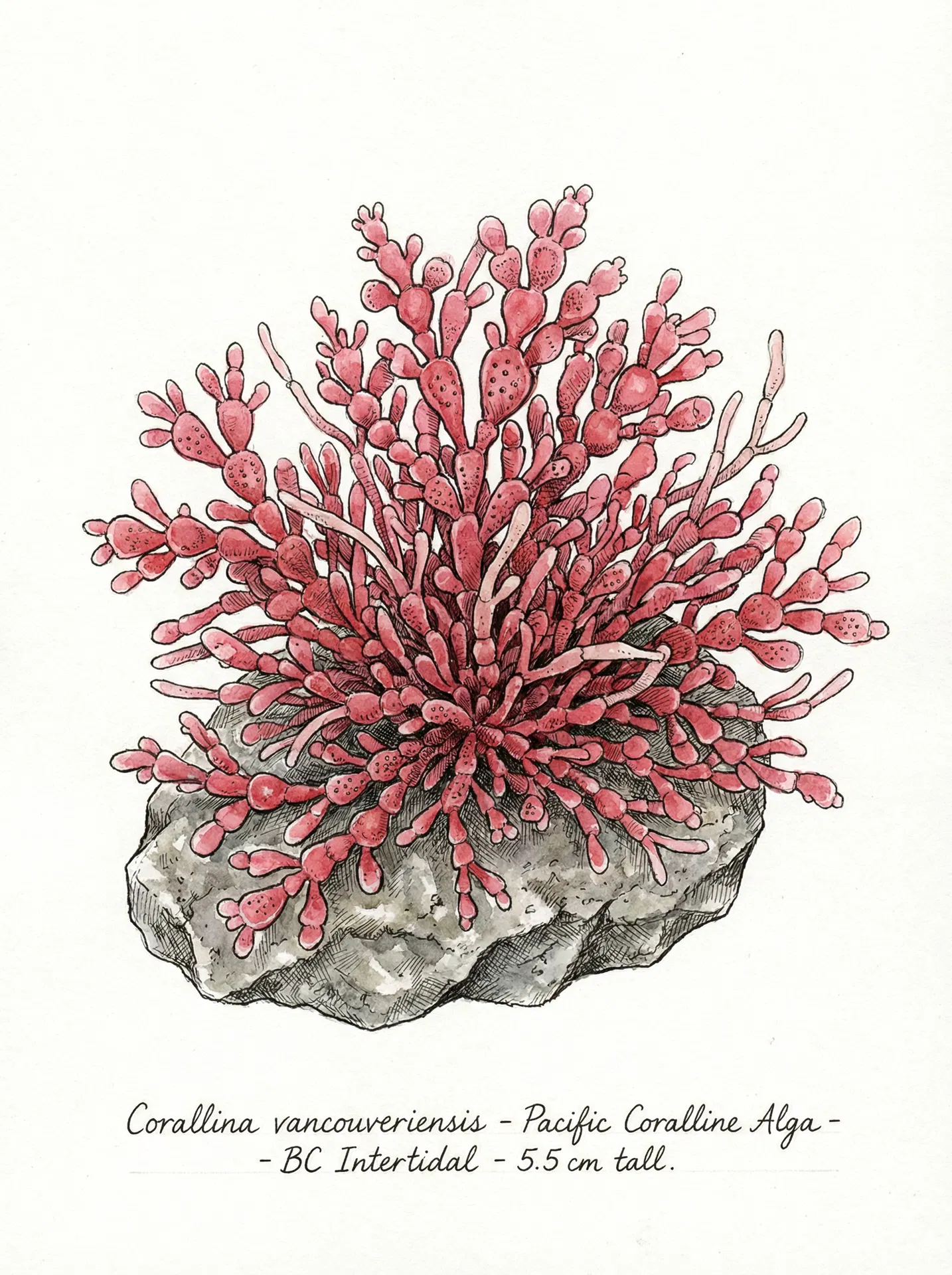
Pacific Coralline Alga
A calcified red alga with rigid, jointed (articulated) fronds of vivid pink to rose-red. Deposits calcium carbonate in its cell walls, creating a hard, coral-like structure. The BC Pacific species — distinct from the Atlantic Corallina officinalis. Forms important biogenic habitat on rocky substrates and is a sensitive indicator of ocean acidification.
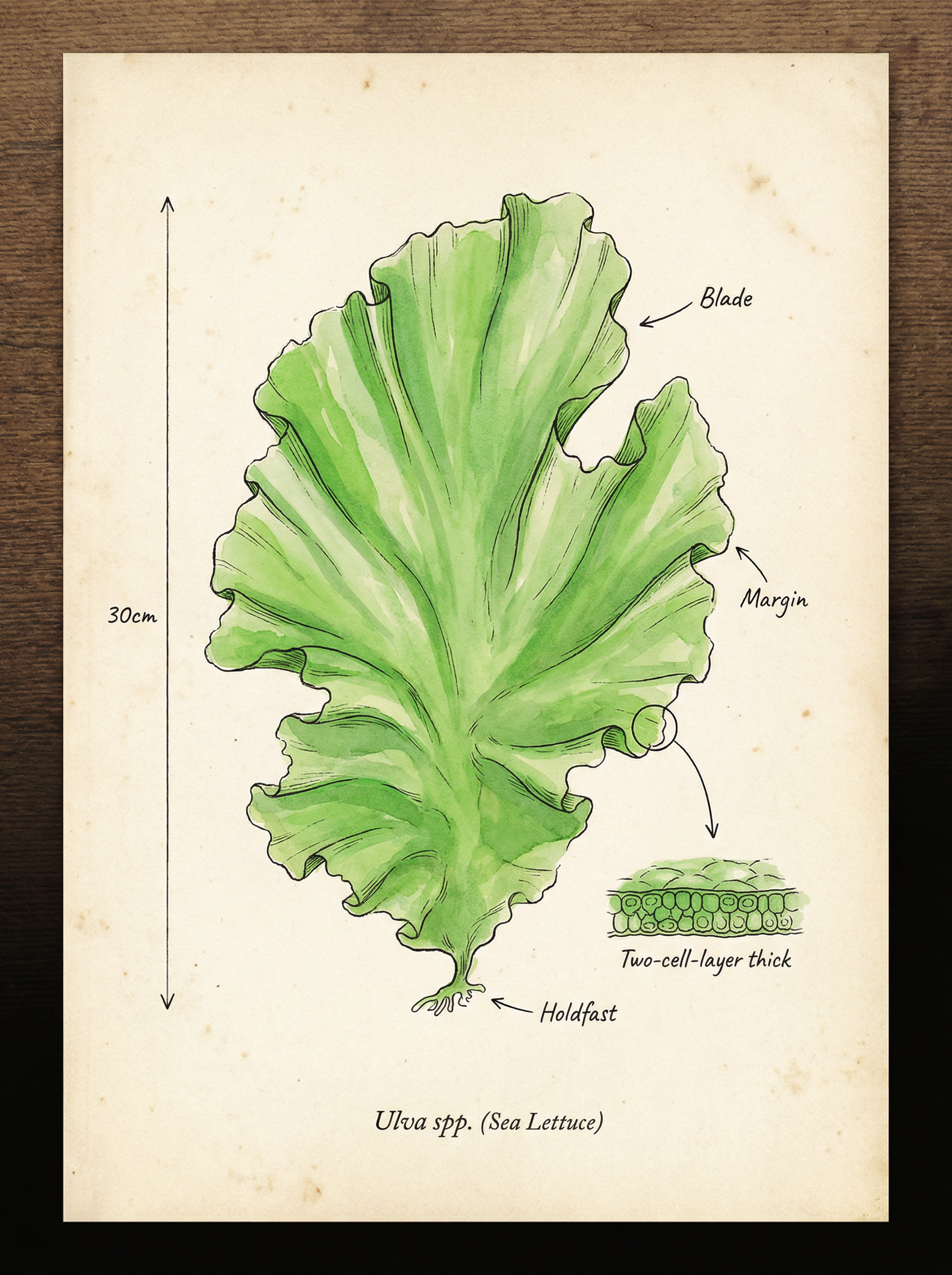
Sea Lettuce
Bright green, translucent, sheet-like fronds — one of the most recognizable seaweeds worldwide. Highly tolerant of nutrient enrichment; can form nuisance blooms in eutrophic waters. Edible and increasingly used in aquaculture.
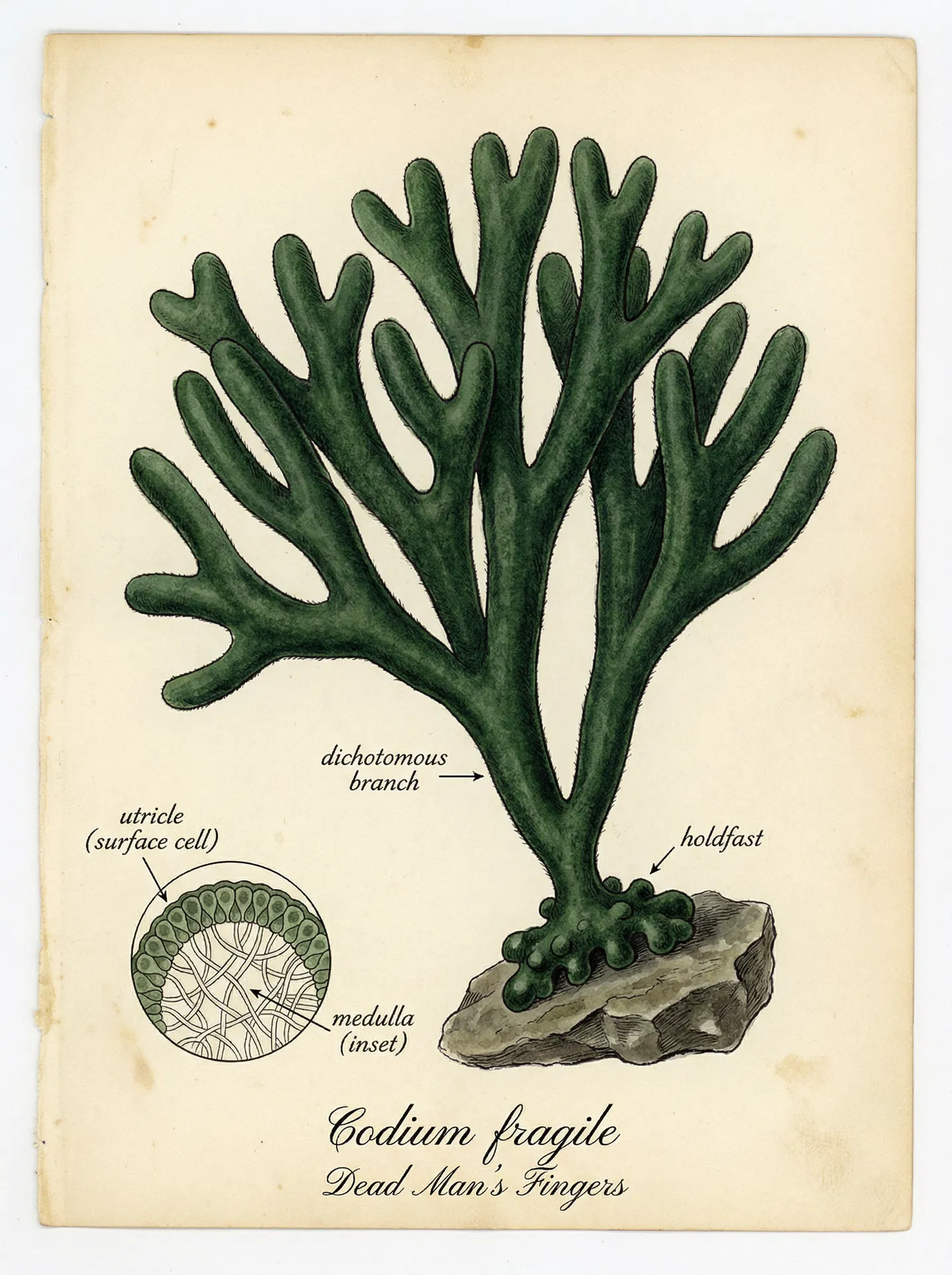
Dead Man's Fingers
Thick, spongy, dark green finger-like fronds with blunt tips. A coenocytic alga — the entire thallus consists of a single giant multinucleate cell with no internal cross-walls. Native to the BC Pacific coast. An invasive subspecies (C. fragile ssp. tomentosoides) has spread to the Atlantic, but the Pacific populations are native and ecologically important.
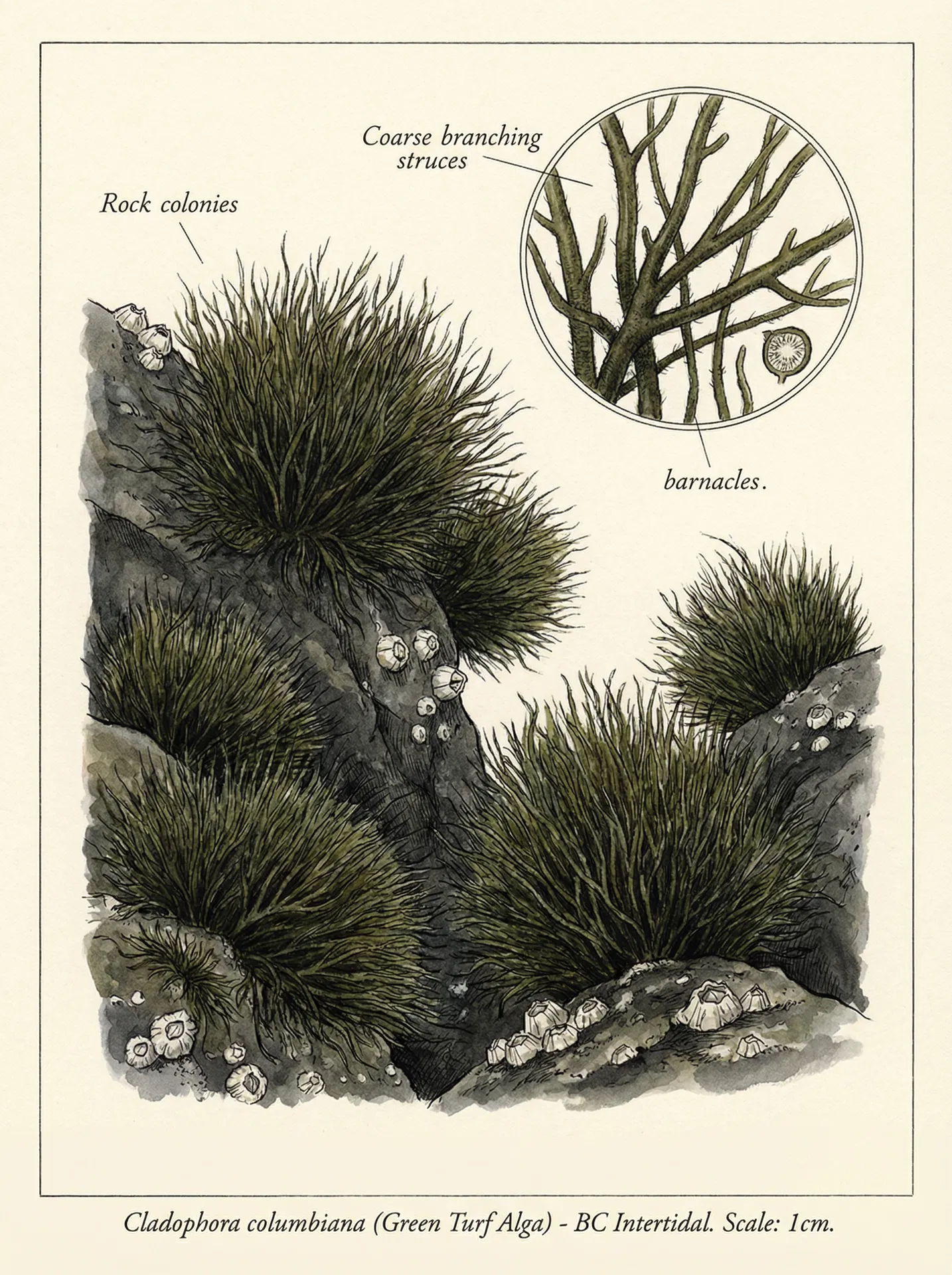
Green Turf Alga
Forms dense, dark olive-green to blackish-green wiry tufts on exposed intertidal rocks, often mixed with barnacles. One of the most abundant green algae on BC's rocky shores. Provides microhabitat for small invertebrates and is an important component of the high intertidal community.